Quantazone is a leading AI Technology Consulting Firm offering next‑gen IT, CRM, ERP, HRMS, and Marketing solutions to drive innovation and growth.

Subscribe to updates
© 2026 Quantazone Updates
Feb 17, 2026

What’s New

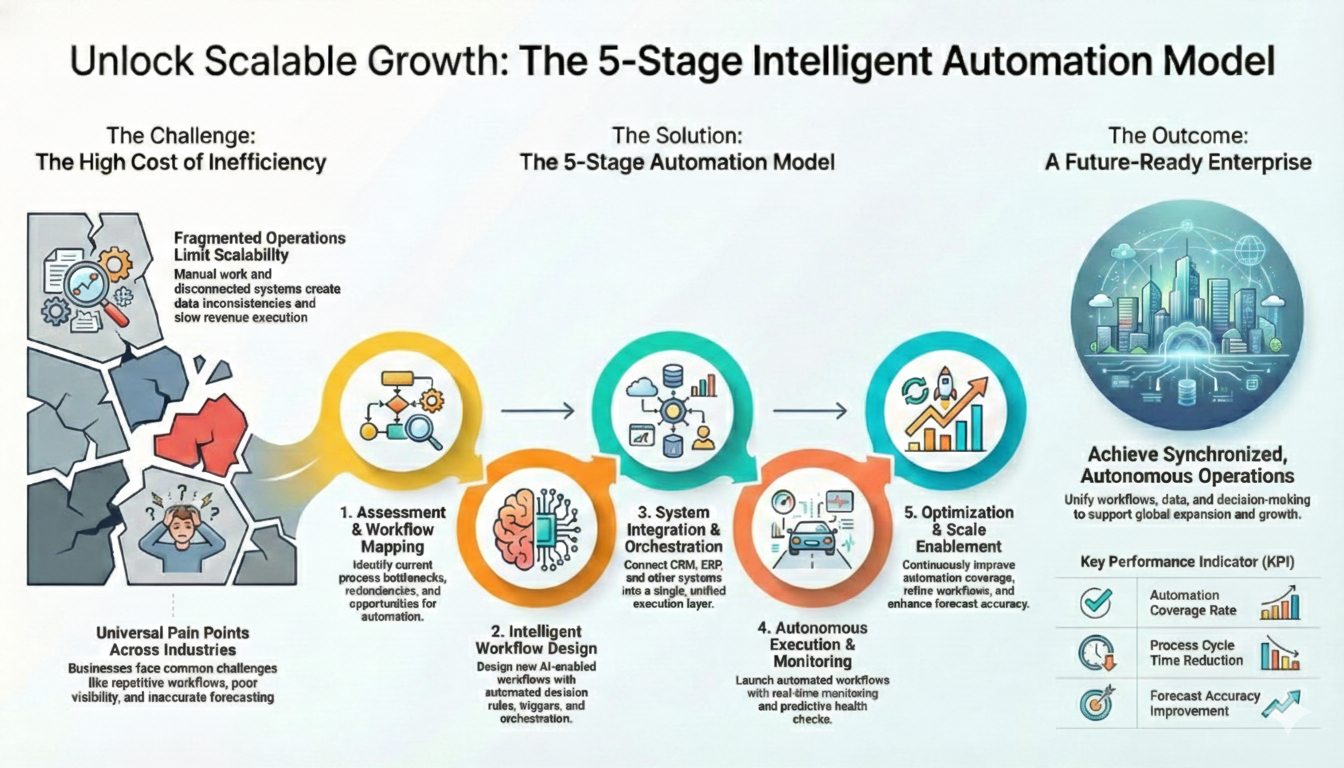
Quantazone’s automation orchestration layer enables organizations to execute workflows with precision, reliability, and predictive intelligence across their core business systems. By strengthening end-to-end workflow mapping, expanding automation triggers, and optimizing real-time orchestration across CRM, ERP, HRMS, and operational platforms, organizations achieve seamless cross-functional coordination without manual intervention.

This orchestration capability allows enterprises to adopt and scale an intelligent business automation operating model, ensuring consistent execution, data integrity, and operational scalability across global environments.


This capability significantly advances how teams adopt and scale their intelligent business automation model for global operations.


Why It Matters

This enhancement directly elevates enterprise performance across the five transformation metrics defined in the KPI Matrix:

  • Automation Coverage Rate: More workflows can now be executed autonomously, increasing overall coverage across sales, service, finance, and operations.
  • Process Cycle Time Reduction: Expanded orchestration triggers accelerate execution and reduce time-to-completion for multi-system processes.
  • Data Accuracy & Sync Reliability: Improved integration logic enhances consistency between interconnected systems and eliminates data drift.
  • Forecast Accuracy Improvement: Higher automation reliability and cleaner data flows strengthen predictive planning across revenue and operations.
  • Operational Scalability Index: Organizations can scale processes across geographies, teams, and products without proportional increases in cost or complexity.

This release strengthens efficiency, compliance, and operational scale in direct alignment with the Transformation Outcome defined in the Content Nucleus.


Who It’s For

This update is designed for:

  • CEOs seeking a scalable operating model
  • CTOs driving modernization initiatives
  • CIOs focused on data governance and system health
  • COOs responsible for workflow performance and execution velocity
  • Operations Teams who manage cross-functional delivery

How It Works

This enhancement operates strictly within the Canonical 5-Stage Intelligent Automation Framework:

  1. Assessment & Workflow Mapping: The system identifies new integration opportunities and bottlenecks, enabling cleaner workflow baselines.
  2. Intelligent Workflow Design: Updated logic and decision paths allow richer automation conditions and more robust exception handling.
  3. System Integration & Orchestration Layer: Enhanced connectors unify data flows and trigger paths across all major business systems.
  4. Autonomous Execution & Monitoring: Automation pipelines now execute tasks with improved speed, accuracy, and SLA tracking.
  5. Optimization & Scale Enablement: Continuous insights refine automation performance and support global-scale operational expansion.

This structured flow ensures the update integrates seamlessly into the broader operating model architecture.
Book a meeting

Feb 16, 2026

What’s New

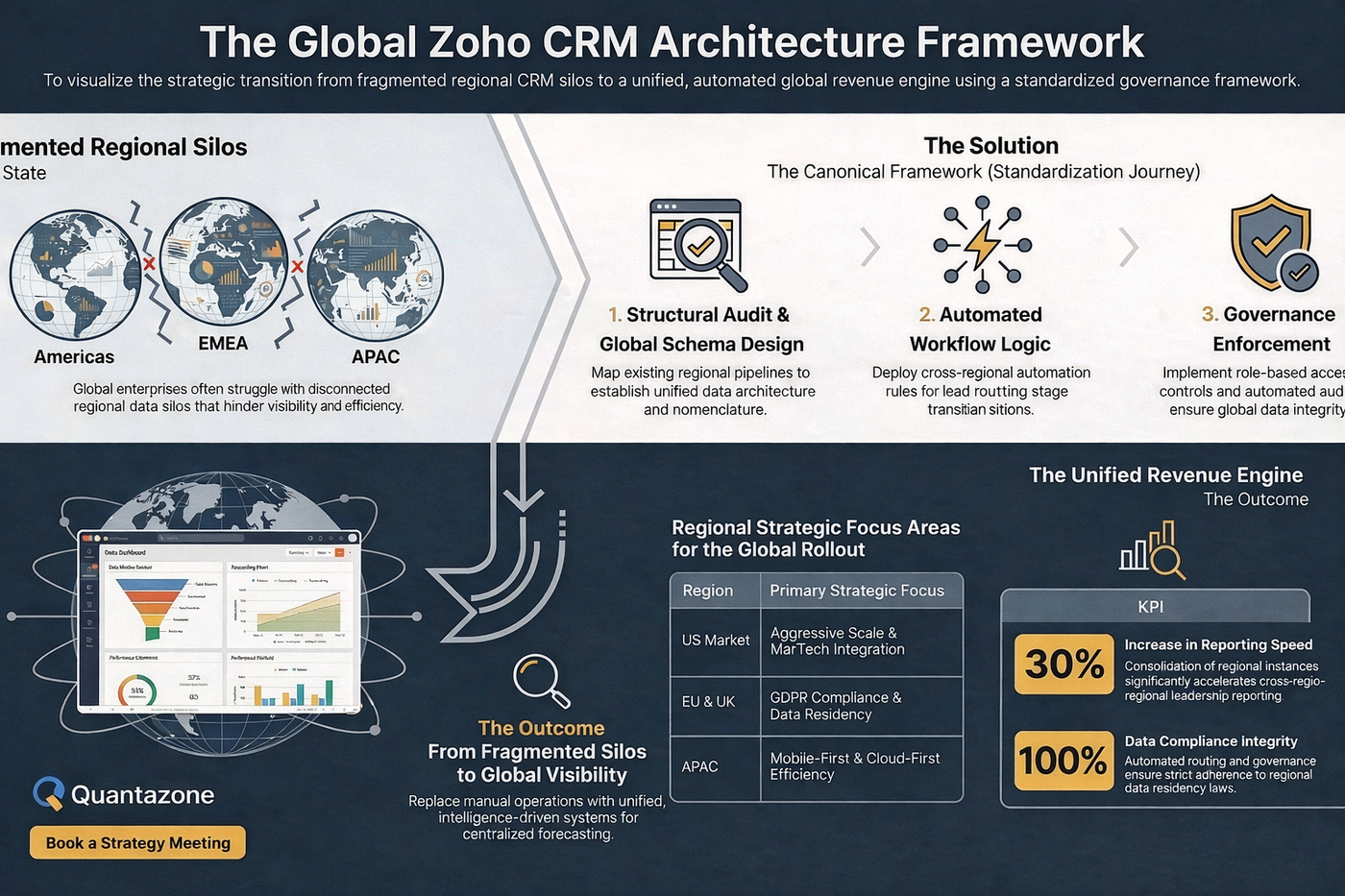
The Unified Global Revenue Architecture for Zoho CRM brings fragmented regional operations into a single, cohesive engine. It incorporates Zia-powered Predictive Automation to evaluate cross-regional data points (deal value, engagement, and history) and enable proactive lead routing. Spaces provide organized work zones that unify apps and live information streams by department or region, reducing interface clutter and improving operational clarity.


Why It Matters

Enterprise organizations gain Global Pipeline Visibility with consistent reporting accuracy across multiple time zones. Automation through Zia Hubs reduces repetitive execution layers, increasing Lead-to-Opportunity Velocity while maintaining a high Data Cleanliness Score through centralized governance.


Who It’s For

Designed for CTOs, Sales Operations Leaders, and Global Revenue Officers who require centralized oversight across diverse regional sales structures.


How It Works

The framework operates through a structured global model:

  • Structural Data Audit: Maps regional schemas to identify nomenclature conflicts.
  • Global Schema Standardization: Aligns unified picklists and mandatory fields across regions.
  • Automated Process Orchestration: Uses Zoho Blueprints to standardize deal stage transitions.
  • Global Governance Enforcement: Applies role-based access control (RBAC) to secure sensitive regional data.

Ready to modernize your enterprise sales engine?

Book a meeting.

Feb 10, 2026

What’s New: Enhanced Vectorization & Contextualization

Version 2.0 reflects refinements in the second and third stages of the framework. The Vectorize & Embed layer now converts unstructured text into high-dimensional semantic vectors that capture intent rather than keywords. The Contextualize layer has been strengthened with deeper domain grounding and more granular Role-Based Access Controls (RBAC), ensuring synthesized responses remain both relevant and secure.


Why It Matters: Reducing Retrieval Latency & Improving Freshness

These enhancements address core enterprise performance requirements. Optimized semantic processing enables retrieval latency under two seconds, supporting faster, decision-ready answers. Knowledge freshness is also improved by minimizing the lag between source updates and their availability in the answer layer—directly reducing the “search tax” that consumes nearly 20% of employee productivity.


Who It’s For: Enterprise Knowledge Managers & CIOs

Knowledge Engine v2.0 is designed for CIOs, CTOs, and Enterprise Knowledge Managers responsible for operating across fragmented data silos such as SharePoint, Slack, and legacy ERP/CRM systems. It provides a reasoning layer that transforms proprietary data into a governed, competitive asset while preserving institutional memory.


How It Works: The Cognitive Knowledge Nexus

The system operates on a structured Cognitive Knowledge Nexus framework:

  • Unify & Ingest: Connects disparate data sources into a continuous pipeline
  • Vectorize & Embed: Encodes semantic meaning for intent-based retrieval
  • Contextualize: Applies security controls and role-based relevance
  • Synthesize: Uses LLMs to generate citation-backed answers
  • Govern & Learn: Maintains output integrity through guardrails and human-in-the-loop feedback

To explore how Knowledge Engine v2.0 modernizes information architecture and improves organizational resolution rates, a strategy discussion can be scheduled.

Book a meeting

Feb 10, 2026

What’s New

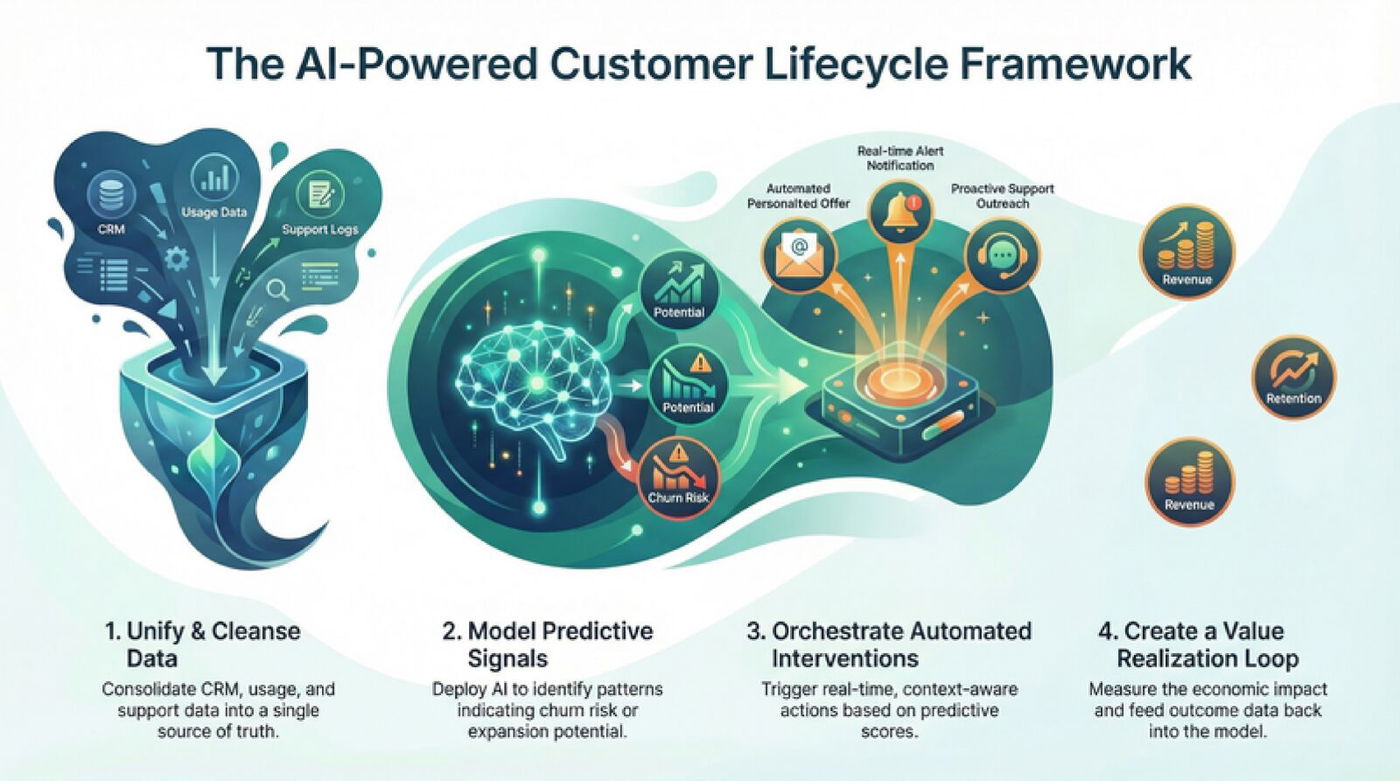
AI Customer Lifecycle Intelligence is a strategic capability designed to transition enterprise organizations from static, reactive account management to a dynamic, predictive operating model. This capability addresses the systemic revenue loss caused by siloed customer data and delayed churn identification by implementing real-time behavioral foresight.


Why It Matters

Traditional subscription models often fail to predict user intent, leading to avoidable revenue erosion. This strategy enables leadership to transform customer management into a self-correcting, revenue-generating engine. Execution of this strategy is measured against specific business outcomes, including:

  • KPI_1: Net Revenue Retention (NRR) Impact
  • KPI_2: Churn Prediction Accuracy (%)
  • KPI_3: Intervention Conversion Rate
  • KPI_4: Customer Lifetime Value (CLTV) Uplift

Who It’s For

This capability is specifically developed for Chief Revenue Officers (CROs) and Chief Marketing Officers (CMOs) aiming to enable and scale predictive retention and growth strategies within global enterprises.


How It Works

The implementation follows the four-step Canonical Framework to ensure data integrity and automated execution:

  • Data Unification & Hygiene: Consolidating fragmented CRM, product usage, and support touchpoints into a clean source of truth.
  • Predictive Signal Modeling: Deploying AI to identify non-linear patterns that indicate churn risk or expansion potential.
  • Automated Intervention Orchestration: Triggering real-time, context-aware actions across channels based on predictive scores.
  • Value Realization Loop: Measuring the economic impact of interventions and feeding that data back into the model to refine accuracy.

Book a meeting

Feb 07, 2026

Drawing from the strategic objective defined in the sources, this release introduces a framework designed to enable CROs and COOs to restructure their revenue functions around AI-driven intelligence.

What's New

This capability represents a shift from intuition-based sales management to a systematic model of data-driven revenue engineering. It replaces fragmented, intuition-led sales silos with a unified, AI-engineered revenue machine designed to predict and capture value with precision.

Why It Matters

Global B2B enterprises frequently face systemic revenue leakage and forecasting inaccuracies due to disjointed processes and siloed data across disparate regions. By implementing this framework, organizations can secure measurable improvements in Forecast Accuracy (+/- 5% variance) and Revenue Leakage Reduction (%). Additionally, the framework is designed to accelerate Sales Cycle Velocity (Days to Close) and optimize the CAC Payback Period (Months) through automated efficiency.

Who It's For

This strategic framework is engineered for enterprise Chief Revenue Officers (CROs), Chief Operating Officers (COOs), and Revenue Operations (RevOps) leaders responsible for global scalability and the modernization of legacy sales structures.

How It Works

The AI Revenue Operations Strategy is executed through the five-step Canonical Framework to ensure operational discipline and predictive precision:

  • Step 1: Data Unification & Hygiene: Consolidating fragmented customer data from CRM, MAP, and ERP systems into a single source of truth.
  • Step 2: Predictive Intelligence Layering: Applying AI models to score leads and identify churn risks in real-time.
  • Step 3: Process Automation & Governance: Automating routine workflows and enforcing strict sales stage entry/exit criteria.
  • Step 4: Cross-Functional Alignment: Synchronizing KPIs and incentives across Marketing, Sales, and Customer Success to eliminate silos.
  • Step 5: Continuous Revenue Optimization: Leveraging AI-driven feedback loops to dynamically adjust territory planning and resource allocation.

Book a meeting 

Feb 05, 2026

What’s New

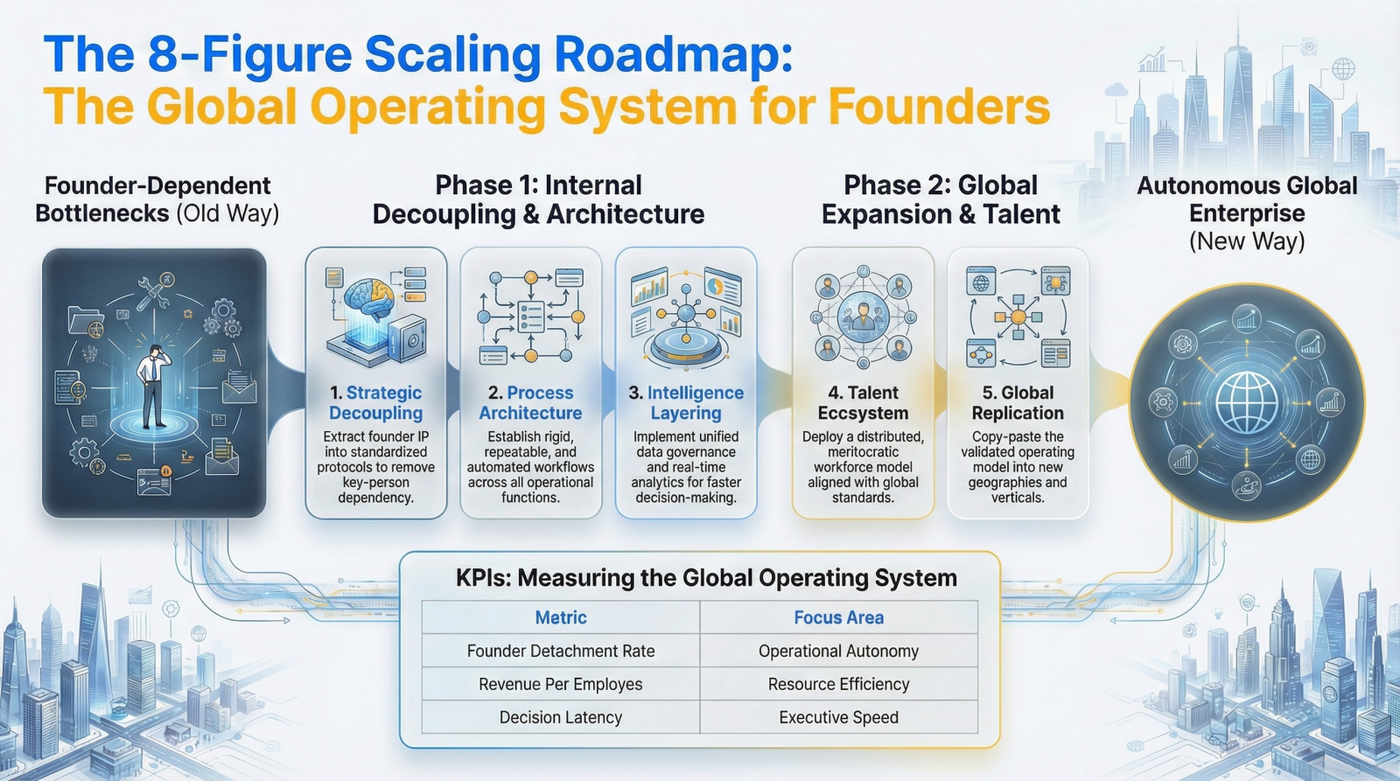
The Global Operating System is a modular infrastructure designed to transition founder-led enterprises from manual oversight to autonomous scale. It provides a structured methodology for operational decoupling, enabling organizations to break through the “Complexity Trap” that commonly emerges around the 7-figure growth stage.

Why It Matters

In high-growth companies, reliance on tribal knowledge and direct founder intervention creates structural bottlenecks. This system shifts operations from ad-hoc execution to systemic scale, directly improving Founder Detachment Rate and Revenue Per Employee.
By establishing a self-healing infrastructure, leadership reduces Decision Latency and reallocates focus from daily firefighting to strategic capital deployment—ensuring revenue growth is no longer tethered to individual human effort.

Who It’s For

Designed for Founder-CEOs and Senior Operations Leaders seeking to systematize their business for multi-region expansion, with a specific focus on the US and GCC/UAE markets.

How It Works

The system is deployed through a five-step Enterprise Scaling Strategy defined by the Canonical Framework:

  1. Strategic Decoupling
    Extracts and codifies founder IP into standardized protocols to eliminate key-person dependency.
  2. Process Architecture
    Establishes rigid, automated workflows to ensure consistent, repeatable quality output.
  3. Intelligence Layering
    Implements unified data governance with real-time operational analytics.
  4. Talent Ecosystem
    Deploys a distributed, meritocratic workforce model aligned with global performance standards.
  5. Global Replication
    Validates and replicates the operating model across new geographies and verticals.

Book a meeting

Feb 04, 2026

What’s New

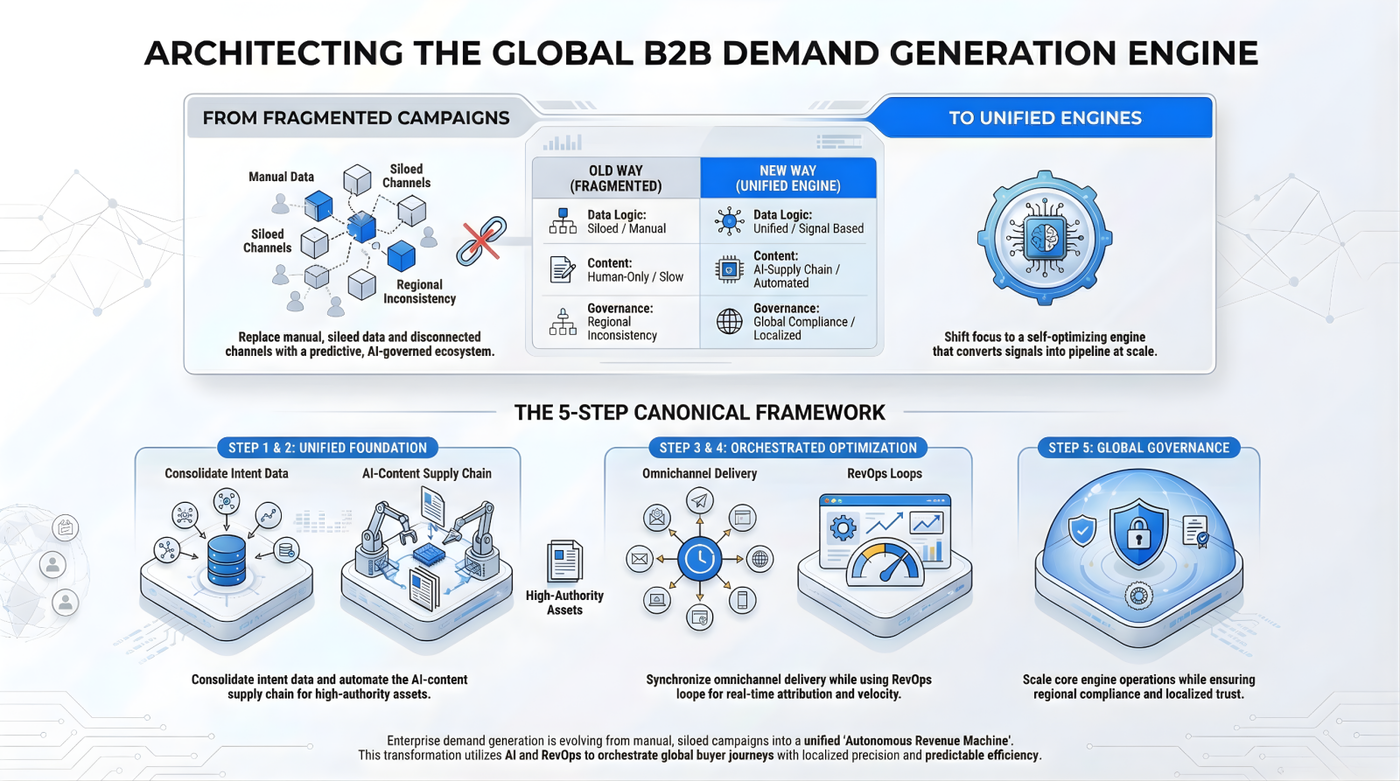
A unified methodology that enables global organizations to move from fragmented, manual campaign execution to an Autonomous Revenue Machine. This approach replaces siloed operations with a self-optimizing Demand Engine model, powered by AI and governed by centralized Revenue Operations. It provides an architectural blueprint for unifying disconnected channels—SEO, Paid Media, and Content—into a single, predictive ecosystem.


Why It Matters

Current approaches to growth are often constrained by signal decay and operational bottlenecks. This engine converts buyer signals into pipeline with predictable efficiency, directly accelerating Pipeline Velocity and optimizing CAC Payback Periods. By integrating data and automating content production, this approach defines the modern Enterprise Demand Generation Strategy—enabling organizations to orchestrate buyer journeys at infinite scale while maintaining strict global compliance.


Who It’s For

This methodology is designed for Global VPs of Growth and Revenue responsible for scaling demand architecture across complex, multi-regional markets.


How It Works

The engine operates on a five-step Canonical Framework:

  • Data Unification & Signal Capture
    Consolidates intent data from first-party (CRM, site) and third-party sources into a single source of truth.
  • AI-Content Supply Chain
    Automates the production and localization of high-authority assets mapped directly to buyer intent.
  • Omnichannel Orchestration
    Synchronizes delivery across SEO, Paid Media, and Email to surround decision-makers.
  • RevOps Feedback Loops
    Establishes real-time attribution and velocity checks to dynamically optimize spend.
  • Global Governance & Localization
    Ensures regional compliance (GDPR and local norms) while scaling the core engine globally.

Book a meeting

Feb 03, 2026

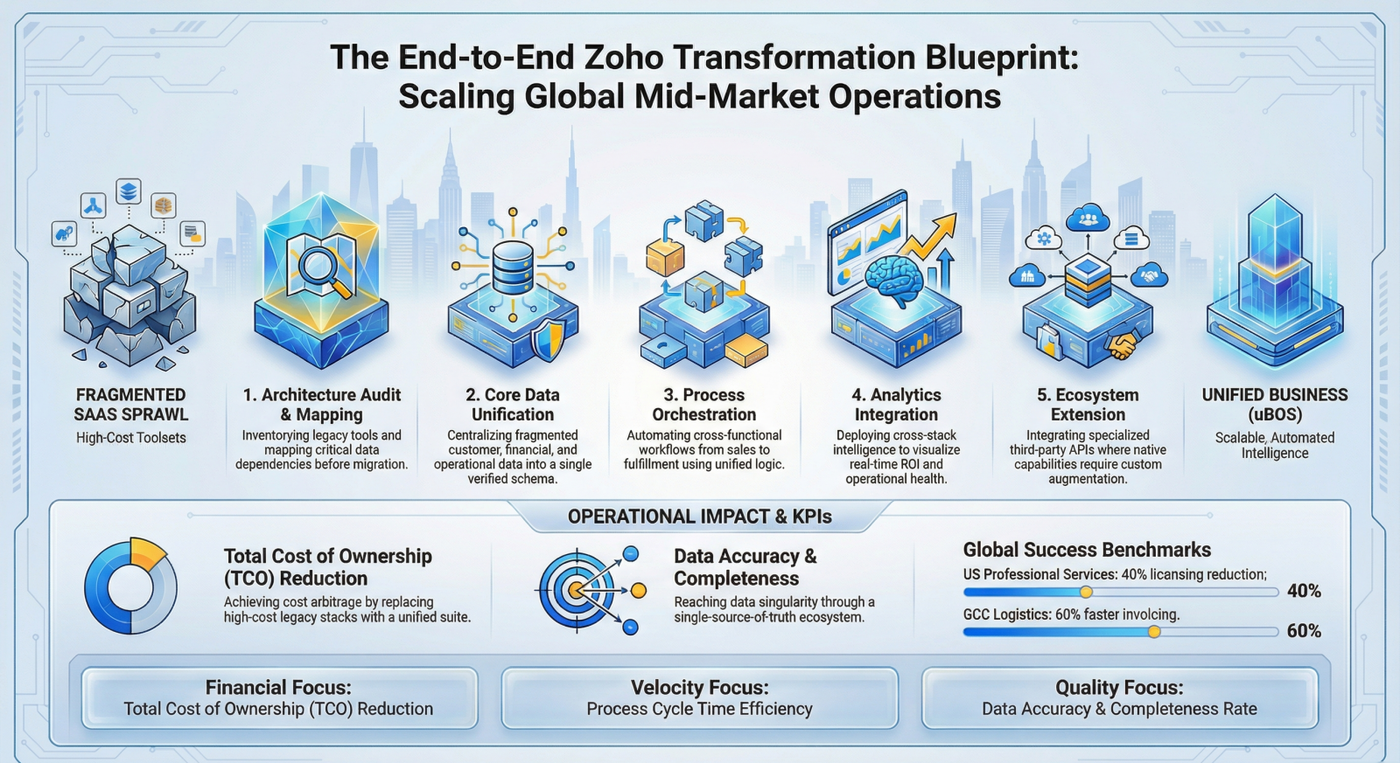
A comprehensive transformation framework designed to transition global mid-market enterprises from fragmented legacy environments to a Unified Business Operating System (uBOS). This blueprint provides a structured methodology to eliminate "SaaS Sprawl" and establish a single-source-of-truth ecosystem that scales horizontally.

Why It Matters

Fragmented ecosystems of disconnected tools create data silos and inflated licensing costs that hinder executive decision-making. By moving to an automated, intelligence-driven operating model, organisations can achieve measurable improvements in several key areas:

  • Total Cost of Ownership (TCO) Reduction.
  • Process Cycle Time Efficiency.
  • Data Accuracy & Completeness Rate.
  • Cross-Departmental Adoption Score.

Who It’s For

This capability is engineered for enterprise-level decision-makers, specifically CTOs and COOs, who are responsible for global operational architecture, digital transformation, and margin efficiency.

How It Works

The deployment of a Zoho Transformation Strategy is executed through the five-step Canonical Framework, ensuring data integrity and operational continuity throughout the transition:

  1. Architecture Audit & Mapping: A rigorous inventory of legacy tools and mapping of data dependencies.
  2. Core Data Unification: Centralising fragmented customer, financial, and operational data into a single verified schema.
  3. Process Orchestration: Automating cross-functional workflows using unified logic across the value chain.
  4. Analytics Integration: Deploying cross-stack intelligence to provide real-time visibility into ROI and operational health.
  5. Ecosystem Extension: Integrating specialised third-party APIs where custom augmentation is required without disrupting the core unified model.

Book a meeting

Jan 31, 2026

In alignment with our strategic objective to enable technical leadership to architect high-performance, low-latency global systems, this release addresses the "geography tax" inherent in legacy hub-and-spoke models. Drawing from the Content Nucleus, this capability marks a shift toward a unified global operating environment where infrastructure performance is decoupled from physical location.

What’s New

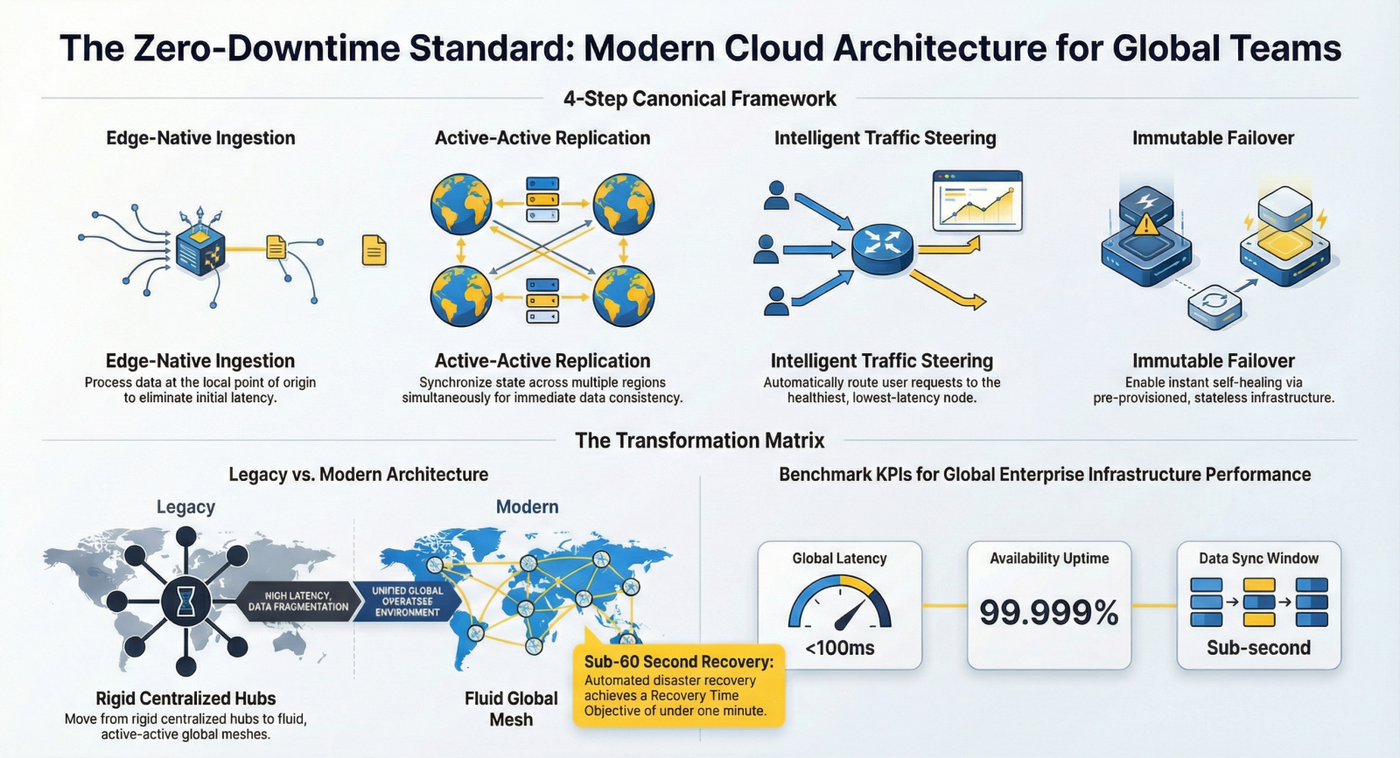
We are introducing a standardized transition path from rigid, centralized architectures to a fluid "Global Mesh" model. This capability allows for the deployment of an Enterprise Global Cloud Architecture that supports distributed teams with zero perceived lag and near-real-time data synchronization.

Why It Matters

This transition is designed to eliminate productivity bottlenecks caused by data fragmentation and regional downtime. By adopting these standards, enterprises can achieve the following verified outcomes from our KPI Matrix:

  • Global Latency Reduction: Maintaining a target of <100ms globally.
  • Availability Uptime: Achieving a standard of 99.999%.
  • Data Consistency Window: Ensuring a sub-second synchronization across all active regions.
  • Failover RTO: Reducing the Recovery Time Objective to less than 60 seconds.

Who It’s For

This release is specifically engineered for CTOs and VPs of Infrastructure responsible for the performance and resilience of global mission-critical systems. It provides the architectural blueprint necessary to support high-volume transaction integrity in the US and navigate the geographic complexities of the APAC region.

How It Works

The capability is delivered through a four-step Canonical Framework that ensures infrastructure remains a velocity driver rather than a bottleneck:

  1. Edge-Native Ingestion: Local processing of data at the point of origin to remove initial latency.
  2. Active-Active Replication: Simultaneous state synchronization across multiple regions for immediate consistency.
  3. Intelligent Traffic Steering: Automated routing of user requests to the healthiest, lowest-latency node.
  4. Immutable Failover: Use of pre-provisioned, stateless infrastructure for automated self-healing and rapid recovery.

Book a meeting

Jan 30, 2026

The Autonomous Agents Module introduces a specialized synthetic AI workforce capable of high-precision back-office execution. Unlike legacy serial processing tools, these agents operate as specialized entities—such as "The Reconciler" and "The Compliance Sentry"—designed to handle complex, high-volume tasks autonomously within a self-healing operational environment.

Why It Matters

This capability is a primary driver for Enterprise AI Workforce Automation, allowing organizations to shift human capital from low-value data entry to strategic oversight. By deploying this module, enterprises can target the following mission-critical benchmarks:

  • Workflow Autonomy Rate: Achieve a target of 40% by 2026.
  • Operational Expense (OPEX) Reduction: Realize a range of 25-35% in savings.
  • Processing Velocity Improvement: Accelerate workflows by 8x-12x compared to manual processing.
  • Compliance Accuracy Rate: Maintain a target accuracy of >99.9%.

Who It’s For

  • Chief Technology Officers (CTOs): To architect a scalable, always-on AI infrastructure.
  • Chief Operating Officers (COOs): To reduce operational debt and improve organizational agility.
  • Heads of Operations: To move from fragmented, serial processing to unified, parallel intelligent execution.

How It Works

The module is deployed through The Agentic Workforce Integration Model, ensuring a structured and governed transition to autonomy:

  1. Decompose & Map: Identifies high-friction workflows and breaks them into discrete, agent-solvable units.
  2. Agent Assignment: Deploys specialized agents to roles identified during mapping.
  3. Orchestration & Handoffs: Establishes a "Manager Layer" where agents hand off tasks or escalate to "Human-in-the-Loop" oversight.
  4. Governance & Scale: Implements real-time monitoring rails to ensure rigorous compliance before scaling across global regions, including the US and UK/EU.

Book a meeting

Jan 28, 2026

Zoho has launched Zoho ERP, a unified platform designed to help manufacturing businesses manage operations, finance, people, and spend—all in one system.

Built to scale with your business, Zoho ERP brings together every critical function without complexity.

Key Features Included in Zoho ERP

Manufacturing & Operations Management – Production planning, work orders, inventory, and order fulfillment
Procurement Management – Purchase requests, vendor management, and purchase orders
Inventory Management – Multi-warehouse tracking, stock control, and material traceability
Finance & Accounting – Invoicing, taxation, banking, compliance, and financial reporting
Payroll Management – Employee payroll processing with statutory compliance
Expense Management – Track, approve, and control business and employee expenses
Analytics & Reporting – Real-time dashboards and insights across all business functions

and much more...

Zoho ERP offers flexible plans and modular scalability, making it ideal for both growing manufacturers and large enterprises.

👉 Book a meeting with our experts to understand how Zoho ERP fits your manufacturing operations.

Jan 01, 2026

Thank you for being a valued part of the Quantazone journey. Your continued trust and partnership across the year have played a key role in everything we’ve built together.

As we enter the New Year, we remain focused on delivering robust solutions, streamlined processes, and measurable growth for your business. We look forward to achieving new milestones together and strengthening our collaboration further. ✨

Wishing you a successful and growth-driven New Year! 🎉